

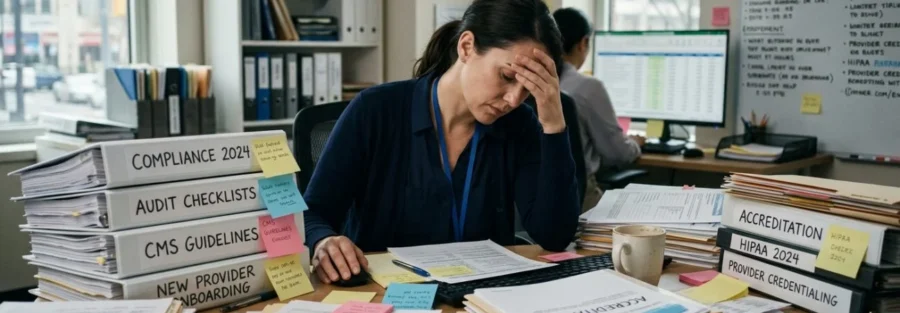
Why Compliance Trips Up New Service Providers
Compliance for new providers in the Australian NDIS and aged care sectors means meeting a complex web of legal and quality standards enforced by oversight bodies like the NDIS Quality and Safeguards Commission and the Aged Care Quality and Safety Commission. These regulators require providers to establish and maintain robust systems for governance, documentation, and ongoing monitoring, making compliance far more than simple box-ticking—it’s about embedding quality and risk management into every level of operations (Australian Government).
Many new service providers struggle to meet these demands because they underestimate the administrative burden and unique regulatory expectations set by sector standards such as the NDIS Practice Standards and the Aged Care Quality Standards. Limited practical experience, gaps in onboarding internal systems, and a lack of awareness around their responsibilities commonly lead to oversights—like missing key record-keeping, neglecting to keep risk registers up to date, or failing to respond promptly to non-conformances discovered during audits (ISO; Aged Care Quality and Safety Commission).
- New organisations should implement a clear compliance register to systematically track obligations and responsibilities from day one.
- Establishing a structured incident management system that aligns with regulatory expectations is crucial to demonstrate audit readiness and support continuous improvement.
Non-compliance with these frameworks increases the risk of regulatory action, reputational damage, or even service suspension—outcomes that are particularly costly in the early stages of operation (NDIS Commission). As the next section explores, developing robust and tailored policies and procedures is the critical starting point for any new provider establishing long-term compliance foundations.
Inadequate Policy and Procedure Development
Weak or missing policies and procedures consistently undermine new NDIS and aged care providers, often leading to significant non-compliance during audits. Australian legislative frameworks expect all registered providers to establish core documents, including incident management, complaints, risk management, governance, and service delivery protocols, each adapted for their unique operations (NDIS Commission; Aged Care Quality and Safety Commission). Relying solely on generic templates, rather than customising procedures for your specific provider context, increases the risk of missing critical compliance obligations and leaves operational blind spots (ISO).
For example, a template-driven incident management policy might satisfy a documentation checklist but fail to address actual escalation pathways, staff roles, or local reporting laws relevant to your organisation’s size and service type. Without tailored registers—for complaints, incidents, or risk assessments—your continuous improvement systems and governance evidence may not stand up to scrutiny during a Commission audit. The Aged Care Quality and Safety Commission regularly highlights the importance of linking policy content to real-world practice and documented decision-making (Aged Care Quality and Safety Commission – Assessment).
- Create and regularly update bespoke registers for incidents, feedback, and risks with input from frontline and management staff.
- Implement a document control system to track policy revisions, ensuring all staff access the current authorised version.
Providers who invest early in thorough, fit-for-purpose policy development are better placed to evidence compliance for auditor interviews and reviews. For guidance on establishing robust governance and documentation frameworks, see NDIS Consultant Services. Up next: a look into risks from underestimating staff onboarding and training requirements.
Underestimating Staff Onboarding and Training Requirements
Many new providers fall into the trap of overlooking comprehensive staff onboarding, missing critical induction documentation or falling short on compliance training requirements. Both the NDIS Commission and the Aged Care Quality and Safety Commission explicitly require that all workers demonstrate competency before commencing unsupervised duties. This means not only ensuring background checks and qualifications, but also maintaining clear evidence of formal induction and job-specific education for every staff member. Failure to meet these obligations puts providers at risk of sanctions and audit nonconformities.
A robust onboarding system is the bedrock of compliance for new providers. Auditors will expect to see complete orientation checklists, staff training registers, and up-to-date records of ongoing refresher sessions. According to Australian Government regulations, it is not enough to verbally brief staff—formal acknowledgement and competency validation must be documented and regularly updated. Automated systems that track and prompt regular refresher training, and provide alerts prior to credential expiries, make ongoing compliance much less labour-intensive and easier to audit. Many providers also implement digital induction modules to ensure every worker receives consistent governance and risk education before accessing client records or entering care environments.
- Set up a secure, centralised staff training register that includes dates, module completion, and supervisor sign-off
- Use a digital onboarding platform with orientation checklists, policy acknowledgement, and automatic reminders for annual NDIS Practice Standards modules
Incorporating rigorous onboarding and proactive training management lays the groundwork for seamless audits and an empowered workforce. As you build these staff governance systems, it’s crucial to integrate them with reliable recordkeeping and registers – the focus of our next section. For specialist support in streamlining governance and compliance for your service, see our Aged Care Compliance Services.
Failing to Establish Effective Recordkeeping and Registers
One of the most common compliance for new providers issues is inadequate recordkeeping, which immediately triggers audit scrutiny from the NDIS Commission and Aged Care Quality and Safety Commission. When provider documents are incomplete, disorganised or unsecured, it becomes nearly impossible to demonstrate compliance across governance, client safety, and continuous improvement requirements. For example, missing or outdated entries in a risk register or continuous improvement register expose organisations to failed assessments and potential sanctions. Typical audit questions will probe how files are maintained, accessed, and protected—making robust systems a non-negotiable for provider compliance success.
Common problems include inconsistent file naming conventions, fragmented registers spread across multiple staff folders, and overlooked requirements for regular document review and sign-off. Without a structured client file management system and formal incident logs, critical details such as consent forms, incident follow-ups, or risk assessments may go unrecorded or get misplaced—a red flag for auditors. For example, some new providers fail to maintain a centralised, access-controlled file structure, risking privacy breaches and gaps in evidence during reviews, as highlighted by the NDIS (Provider Registration and Practice Standards) Rules 2018 and ISO 27001 Information Security Standard.
- Develop a single, centralised register system for incidents, complaints, risks, and continuous improvement activities with strict version controls.
- Implement a digital client file management platform with tiered permission levels and automatic audit trails for every update or access event.
By embedding these governance frameworks, your organisation’s records will withstand scrutiny and build a strong foundation for ongoing compliance. Setting up these processes early not only prevents easy-to-make mistakes, but also streamlines your response in the event of an external audit or certification check—especially when seeking advanced support through services like ISO Certification Support Services. This paves the way for a proactive approach as we explore risk management and continuous improvement in the following section.
Neglecting Risk Management and Continuous Improvement
Failing to prioritise risk management and continuous improvement processes is a common compliance pitfall for new NDIS and aged care providers. The NDIS Commission and the Aged Care Quality and Safety Commission both require service providers to maintain a proactive risk management system and demonstrate an ongoing commitment to quality enhancement. Overlooking these requirements leaves organisations vulnerable to compliance breaches, reputational damage, and possible sanctions.
A basic risk register should document risks related to privacy, health and safety, service delivery, and business continuity. This register must specify risk likelihood, consequence, mitigation actions, and responsible persons. Meanwhile, a continuous improvement register should log identified improvement opportunities, corrective actions, and track the status of implementation, supporting ongoing internal audits and reviews. The lack of robust registers often stems from insufficient understanding of regulatory expectations and the assumption that basic policies cover all risk needs (ISO 27001).
- Designate a compliance coordinator to regularly update and review your risk and continuous improvement registers.
- Use digital platforms or compliance management software to enable evidence-based tracking and reporting, ensuring timely responses during audits.
Providers frequently make the mistake of treating risk and improvement records as one-off documents instead of dynamic tools for organisational learning and regulatory adherence. Embedding regular review cycles and staff training into your governance framework, as endorsed by the Australian Department of Health and Aged Care, positions your organisation for stronger compliance and smoother audit outcomes. In the next section, we’ll explore why robust incident and complaints management is equally critical to your compliance journey.
Poor Incident and Complaints Management Processes
Ineffective incident and complaints management exposes new NDIS and aged care providers to significant compliance breaches, particularly when there’s a failure to promptly report serious incidents or adequately address participant feedback. Both the NDIS Quality and Safeguards Commission and the Aged Care Quality and Safety Commission require robust systems that capture, triage, and escalate incidents, ensuring no risk goes unaddressed and every complaint is actioned promptly.
Inadequate processes—such as documenting issues only sporadically, or a lack of clear pathways for escalation—can lead to regulatory action and erosion of participant trust. For example, both NDIS providers and approved aged care providers must demonstrate their ability to maintain detailed registers and conduct thorough investigations into complaints and reportable incidents as outlined in the NDIS (Incident Management and Reportable Incidents) Rules and Standards like ISO 45001. Lapses can lead to not just compliance penalties, but also compromise of service users’ rights and safety.
- Introduce integrated digital registers to log, track, and auto-escalate every incident or complaint requiring provider or Responsible Person review.
- Use documented procedures that require regular review, trend analysis, and scheduled audits of both incident logs and complaints management processes.
For Responsible Persons and compliance officers, routinely reviewing processes and learning from feedback—rather than reacting only when issues surface during audits—builds a proactive culture of quality improvement. An embedded incident/complaints system is also pivotal for reflecting sound governance and audit readiness, setting the stage for robust provider structures discussed next in Overlooking Governance, Roles, and Responsibilities.
Overlooking Governance, Roles, and Responsibilities
A surprisingly common compliance mistake among new NDIS and aged care providers is neglecting clear governance structures and defined roles, which leaves organisations vulnerable during audits and can undermine operational integrity (NDIS Commission). Robust governance arrangements create the foundation for risk management and accountability—without these, providers run the risk of non-compliance findings, threatening both registration and reputation.
A simple yet effective governance framework should articulate director or owner responsibilities, clear reporting lines, and decision-making authority. For example, the Australian Aged Care Quality and Safety Commission expects providers to have systems that demonstrate oversight, such as recorded board meetings and documented delegations of authority (ACQSC, Standard 8). Too often, small providers allocate compliance or safeguarding as ‘everyone’s job,’ resulting in no single point of accountability, infrequent meetings, and role confusion among staff and management. When governance responsibilities overlap or are undefined, evidence of compliance—such as risk registers, incident investigations, or policy reviews—can fall through the cracks, causing failure at quality audits.
- Appoint a designated compliance lead with specific duties around monitoring legislative changes, overseeing policy updates, and driving regular compliance reporting to the board.
- Establish a governance calendar, requiring documented board or management meetings at set intervals, with standing items like risk reviews and policy registers for NDIS or aged care requirements (ISO 27001).
- Implement an organisational chart and responsibilities register, making reporting lines transparent for both staff and the NDIS Provider registration process (NDIS Provider Registration).
Establishing a robust governance structure isn’t just about passing audits—it’s the backbone of sustainable provider growth and operational confidence. With these governance foundations in place, organisations are well positioned to move on to developing internal review systems and strengthening audit readiness. For support in building scalable compliance processes, see Business Growth Strategy Services.
Missing the Importance of Internal Reviews and Audit Readiness
A major compliance mistake for new providers is failing to recognise the value of ongoing internal reviews and being unprepared for formal audits. Without routine self-assessment and document checks, gaps in evidence and process can easily be missed—issues that typically emerge only when external auditors scrutinise provider systems. The NDIS Quality Indicators make clear that services must demonstrate a “cycle of continuous improvement” using robust governance, but new entrants often underestimate just how vital proactive compliance for new providers is to their long-term viability.
Regular use of self-audit templates, compliance checklists, and internal document control systems forms the backbone of audit readiness. By frequently reviewing policies, registers, and training records, providers can identify areas for improvement before an external assessment. This not only supports regulatory obligations but also ensures that the provider is always prepared to show evidence of their compliance systems, as emphasised by the Aged Care Quality and Safety Commission. Being consistent with internal reviews helps spot outdated documents, missing records, and non-conformances early, thereby reducing risk during regulatory or certification audits.
- Schedule quarterly mock audits using NDIS self-assessment tools and maintain detailed audit trails in a secure document management system.
- Implement a centralised policy register and version control system, such as an ISO-aligned platform, to manage compliance updates and staff notifications effectively (ISO 27001).
Investing early in audit readiness and governance processes is a core principle of compliance for new providers and sets your organisation up for successful, stress-free external reviews. Using smart self-audit frameworks and digital registers shows auditors your commitment to best practice and strengthens your capacity as a registered provider (Australian Government). To ensure your organisation is always prepared, consider booking a tailored compliance consultation with our expert team.