
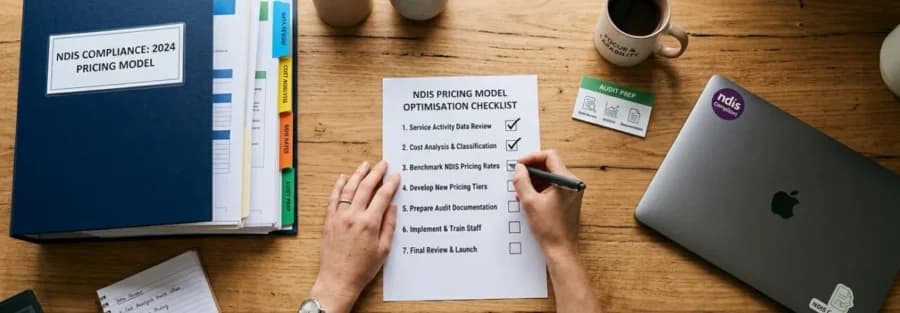
To keep NDIS pricing and billing compliant, charge within the NDIA's current Pricing Arrangements and Price Limits, agree prices with each participant in writing, and bill only for supports you delivered and can evidence. Most billing problems come from small gaps between those three things, such as an old rate left in the system or a claim with no matching progress note.
This checklist covers the everyday controls that keep your pricing defensible. It also sets out the steps to take each time the NDIA updates its pricing arrangements. It is written for NDIS providers of any size.
Why pricing and billing are a compliance issue
Participant funds are public money. The NDIA sets the price limits and claiming rules, and the NDIS Quality and Safeguards Commission oversees how providers treat participants, including how they set and charge prices.
An overcharge that looks like a data entry slip can still lead to a repayment, a complaint or an audit finding. Repeated errors suggest your systems are not under control. That is much harder to explain than a single mistake.
- Name one person who owns pricing, from the price list through to the billing system.
- Keep a written pricing and billing procedure, and review it at least once a year.
- Record every pricing decision and the reason for it.
Check every price against the current Pricing Arrangements
Start with your price list. Every support you offer should map to the correct support item in the NDIA's current Pricing Arrangements and Price Limits. Your price should sit at or below the limit that applies.
Price limits can vary with location, time of day, day of the week and other conditions. A price that is right for a weekday daytime shift may be wrong for an evening shift or a remote area. Check the variations as well as the base rate.
- List every support item you bill, with its item number, unit, your price and the limit that applies.
- Check that each support item matches what the worker actually does, rather than the closest code you can find.
- Remove items you no longer deliver, so nobody selects them by mistake.
- Keep a dated copy of the Pricing Arrangements document you checked against.
Keep service agreements and quotes clear
A participant should know what a support will cost before it starts. Your service agreement or schedule of supports should list each support, its price, how often it is delivered and how changes will be handled.
Write it in plain language and offer it in a format the participant can use. If a participant or their nominee cannot follow the agreement, it is hard to show they agreed to the price.
- Explain how travel, non-face-to-face time and cancellations are charged, and charge them only where the current rules allow.
- State how much notice you will give before prices change.
- Keep signed agreements, or a record of verbal agreement, on the participant's file.
Bill only for what was delivered, and keep the evidence
Every claim should trace back to a record of the support: who delivered it, when, for how long and what was done. Rosters on their own are not enough, because a rostered shift can change on the day.
Common billing errors include claims for shifts that were cut short, duplicate claims after a system retry, and the wrong ratio claimed for group supports. Each one is easy to catch if someone compares claims against progress notes before they go out.
- Match each claim to a progress note or timesheet before you submit it.
- Check group supports against attendance records and the ratio actually delivered.
- Reconcile payments each month and correct errors quickly, with a note of what happened.
- If you find an overcharge, correct the claim and tell the participant or their plan manager.
Good progress notes help with far more than billing. Our service delivery quality improvement checklist covers how to keep them consistent.
What to do when the NDIA changes its pricing arrangements
The NDIA reviews its pricing arrangements regularly and can make changes during the year. Treat each update as a small project, with an owner and a date by which every step is done.
- Read the changes. Compare the new Pricing Arrangements and Price Limits with the previous version. List every support item, price limit or claiming rule that affects you.
- Update your price list. Change prices, item numbers and descriptions. Keep the old list for your records.
- Review service agreements. Work out which participants are affected and whether their schedule of supports needs updating.
- Tell participants. Write to each affected participant, or their nominee or plan manager, before new prices apply. Explain the change in plain language.
- Update billing systems. Load the new rates, then test a sample of claims for each support type before the change date.
- Train staff. Brief rostering, finance and intake staff on what has changed and who to ask with questions.
- Keep evidence. File the change log, participant letters, test results and training records together.
After the first billing cycle on the new prices, check a sample of claims again. Errors from a pricing change usually show up in the first few weeks.
Build pricing into your audit and review cycle
Auditors may ask how you set prices, how you tell participants about them and how you check claims. A short evidence folder answers most of those questions.
- Keep your pricing procedure, current price list and change log together.
- Add a billing sample to your internal audit calendar, for example every quarter.
- Log billing complaints and errors in your complaints and improvement registers.
- Check that your prices cover your real costs, so the business does not rely on errors or shortcuts to stay viable.
If pricing is part of a wider look at your business model, our business growth strategy work covers costing and service mix. For audit preparation in general, see common audit readiness mistakes.
Our NDIS consultant services include a pricing and billing review against the current arrangements. We quote a fixed fee after a free 15-minute call. Book a call.
Frequently asked questions
Can we charge less than the NDIS price limit?
Yes. Price limits are a maximum, so you can charge less as long as the price is agreed with the participant.
How often should we check our prices?
Check them every time the NDIA updates its Pricing Arrangements and Price Limits, and at least once a year otherwise. Check them again whenever you add a new service.
Do we need a new service agreement when prices change?
Not always, but the participant needs to know about the change before it applies. Check what your current agreement says about price changes and update the schedule of supports where needed.
What should we do if we have overcharged a participant?
Correct it straight away. Fix the claim, tell the participant or their plan manager, record what happened and change the step that let the error through.